
Six layers underneath. One workspace on top.
Language models, a kit of real tools, your lab's records and memory, and approval steps work together, so what you use is one connected workspace.
The editor, the workflow canvas, the notebook and the chat, in one place. Everything below shows up here.
High-risk actions, including sequence changes, wait on an approval card.
Lab-wide facts shared with members, private facts that stay with their author in that lab, and your own preferences. Review them in the memory explorer.
Plasmids, workflows, notebook entries and tasks the assistant can look up within your access. Retrieved records can appear as clickable source chips.
Core and specialist agents handle requests and choose which tools to run.
A curated kit of 90+ tools, including 31 deterministic compute tools. Capabilities include primer design, Tm calculation, assembly and restriction analysis, codon optimization, and BLAST searches.
Anthropic is the primary chat provider, with OpenAI as a fallback; OpenAI embeddings power memory search. The models reason and write, and call the tool kit for calculations.
Same mistake. Caught on Day 0 instead of Day 3.
A Gibson overlap that's too short. Today it can show up as an empty plate and a reorder. In Plasmole, the overlap check flags it while you design.
- Primer turnaround, accessed October 2026: IDT Custom DNA Oligos (over 90% of standard orders ship within 24 hours; next-business-day delivery at the fastest); Eurofins Genomics EU salt-free oligos (1–3 working days); Thermo Fisher desalted primers (within 3 business days).
- Addgene protocols, Bacterial transformation (plates overnight at 37 °C) and Inoculating a bacterial culture (12–18 h); Thermo Fisher bacterial transformation workflow.
- Sanger turnaround, accessed October 2026: GENEWIZ/Azenta (results by noon the next business day after receipt); Eurofins Genomics (99% of tube results the next morning). Shipping time comes on top.
- Bai et al., Nucleic Acids Research 53(14), 2025: of 2,521 lab-made plasmids, 384 (about 15%) had design errors; 91 of 259 sequenced plasmids differed from the sender's reference. Peer reviewed; the authors work for a plasmid vendor.
Ask about past attempts, then design.
Find what your lab tried
Ask in plain words. It searches your notebook.
Catch it before you order
The overlap check flags a 12 bp overlap.
Redesign in the same chat
New primers and the workflow, ready to review.
- Searching your labpET-28a Gibson2 results
- Reading a notebook entryGibson: GFP into pET-28a
- Reading a notebook entryGibson: sfGFP into pET-28a
Two Gibson attempts are logged, on 14 Aug and 2 Sep. Both gave empty Kan plates while the controls grew, and both used short overlaps: 16 bp, then 18 bp.
01 is a real turn in an example lab. 02's check messages and 03's primer numbers are Plasmole's real output; the rest is example data.
In Plasmole, or in the AI chat you already use.
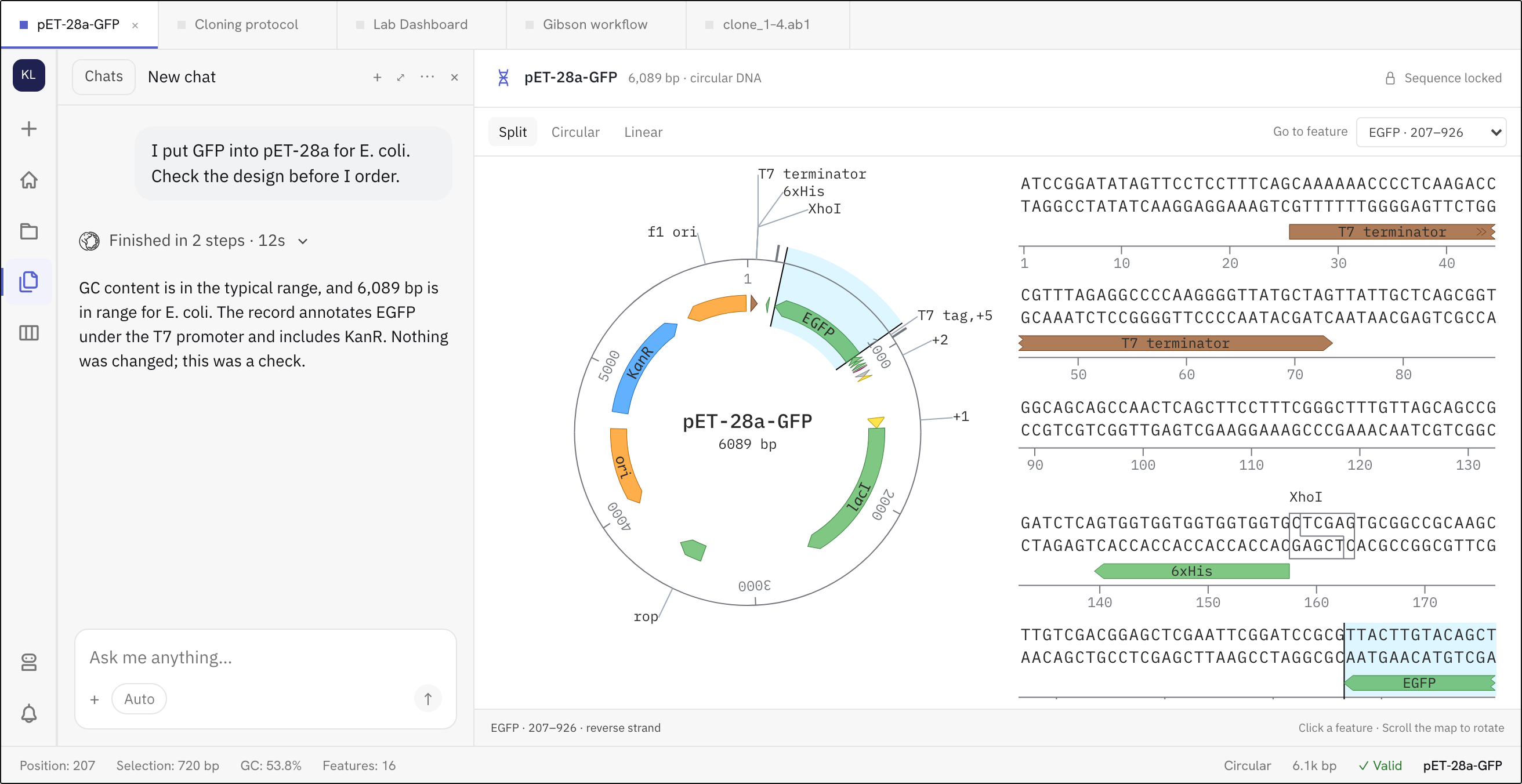
In the workspace
The chat sits beside the editor, the workflow canvas and the notebook, and works from your lab's records.
See the productIn Claude, ChatGPT and Codex
Add Plasmole's connector, and your assistant gets 22 tools, including deterministic calculations on the sequences you give it. It doesn't read your library.
Set up the connectorHow Plasmole AI is different.
Primer3, Biopython and pydna compute primers, Tm, digests and assemblies. 31 of the 90+ tools are deterministic: the same inputs and settings give the same numbers.
Every answer that used a tool gets a second pass: a reviewer reads the tool log and the answer side by side, looking for a result claimed from a tool that failed, a number from a tool that never ran, and a claim no tool supports.
If it can fix the answer from the tool results it does, labels it Corrected by review and keeps the draft one click away. A problem it can't fix is Review flagged issues. A check that can't finish says Unreviewed. Short answers and chat with no tools skip it.
Changes to a sequence or the notebook wait on an approval card that describes the change, and run only after you approve them.
It reads your plasmids, entries and tasks with your permissions, in the workspace you're in. Each step is named, and chips open the records it used.
Illustrations with example data
The people rotate. The lab remembers.
Lab Brain keeps what your lab has settled, with the person who taught it attached. Every answer that uses it says so.
- General
Use Gibson assembly for builds with fewer than 4 parts.
Taught by Maya Chen · used in 14 conversationsMake privateEditDelete from lab brain - General
Our default strain for cloning is E. coli DH5α.
Taught by Adi Kulkarni · used in 31 conversationsMake privateEditDelete from lab brain - Project
The mCherry reporter line is on hold until the new stock arrives.
Taught by Priya Natarajan · used in 3 conversationsMake privateEditDelete from lab brain
Shared with the lab
Conventions, defaults and decisions every member's assistant works from. Each one names who taught it.
Private to you
Facts that stay with their author, in that lab. Nobody else's assistant sees them.
Follows you
Your own preferences travel with you between workspaces. Lab memory never leaves its workspace.
Yours to review
Members read everything in the Memory Explorer and edit or delete what they taught it. A lab fact can be made private again.
- Which strain do we clone in?
- What did the lab decide about Gibson for small builds?
- Which projects are on hold, and why?
- Who ran the last GFP plate, and what was overdue?
Memory is context for lab questions. Designs and sequence analysis run from your records and the tool kit, not from memory.
What teams ask before they turn it on.
More on how data moves in the security overview.
Can it be wrong?
Yes. It's a language model working with tools. The chat shows the tools it calls with result previews, so check the proposed design before you use it. High-risk actions wait for your approval.
Which models does it use?
The base of our intelligence layer is a frontier model.
Do you train models on our research?
No. Plasmole doesn't train models on your research, and Anthropic and OpenAI state that they don't use API data to train their models by default.
Can it change our data without asking?
High-risk actions, including changes to a sequence, wait on an approval card until you approve them. Some lower-risk actions run directly, such as saving designed primers.
Can we turn it off?
Yes. We switch AI processing off for a workspace when your agreement requires it.